On this page

Longer articles

Emotional deep point of view

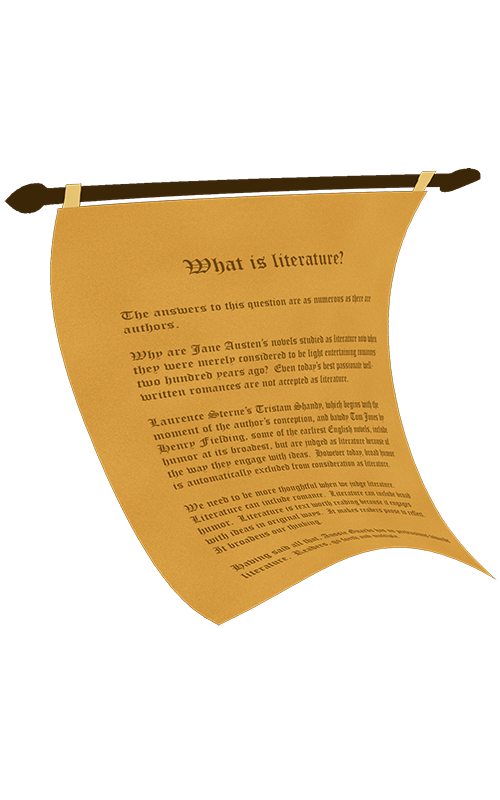
What is literature?

by Sheila Strine

9 March 2025

The answers to this question are as numerous as there are readers.

Why are Jane Austen’s novels studied as literature now when they were considered to be merely light entertainment two hundred years ago? Today’s best-written passionate romances are not accepted as literature. They are assumed to be derivative, poorly written and low-brow, based on their genre.

Laurence Sterne’s Tristram Shandy, which begins with the moment of the author’s conception, and equally bawdy Tom Jones by Henry Fielding, are some of the earliest English novels. They include humor at its broadest, but are judged to be literature because of the way they engage with ideas. However today, broad humor is automatically excluded from consideration as literature.

We need to be thoughtful when we judge literature. Literature can include romance. Literature can include broad humor. Literature is text worth reading because it engages with ideas in original ways. It makes readers pause to reflect. It broadens our thinking.

Having said all that, I do not claim to have any pretensions towards being a literary figure. Readers, enjoy yourselves!

A twisted parchment attached to a rod has old-fashioned letters spelling out the title What is literature?  5 paragraphs follow but they are hard to read.

Links for sharing this article

The black moment in romance

by Sheila Strine

9 March 2025 updated 4 June 2026

In what Joseph Campbell called the dark night of the soul, there is a moment in a hero's journey when everything seems lost. The character finally recognizes what needs to be done in their life and they resolve to take painful action.

This black moment is a lot more than a device for heightening emotions by making the reader sad before everything turns into a triumphant happy ending. It tests the entire premise of the story. In the case of a romance, it tests the strength of the love between the characters.

So how does it work? The black moment is a moment of crisis for a character, when all their efforts seem to have failed. In this moment, the character experiences what their life without the love they have striven for. It is strongest when the crisis is of their own doing and they cannot blame external circumstances for their predicament.

The character faces a stark choice—will they sacrifice everything else for love?

The choice is not easy (it is a BLACK moment) but in a happy-ever-after romance, the sacrifice they make leads to joy. Without making a sacrifice, the thesis is not proved. How can a reader be sure the character is genuinely in love if they have skipped to a happy ending without striving for it?

The main difference between a romance and other genres is that both characters have heroic arcs. Both characters need to face black moments, but it is best if the story does not have a double dip into depression, or it will not be a strong story. It is disconcerting to read one character overcoming doubts and then having to plow through the other character having doubts. Characters do not have identical romantic drives or need attention from each other in the same way, so if the romance is well-constructed, there will be one turning point which motivates each of them to change their lives and choose each other.

A narrow head and shoulder shot showing a man with a scar over his left eye frowning in anguish as he embraces a woman with loose locks of hair hiding her face.

Links for sharing this article